Table Of Content
- A young Washington demonstrated his honest character after coming clean about chopping down his father's cherry tree
- Lady Gaga cancels sister’s bachelorette party at LES club The Box after pressure over sex harassment suit
- The Washingtons used style in politics
- George Washington’s Hair: How Early Americans Remembered Their Founders by Keith Beutler
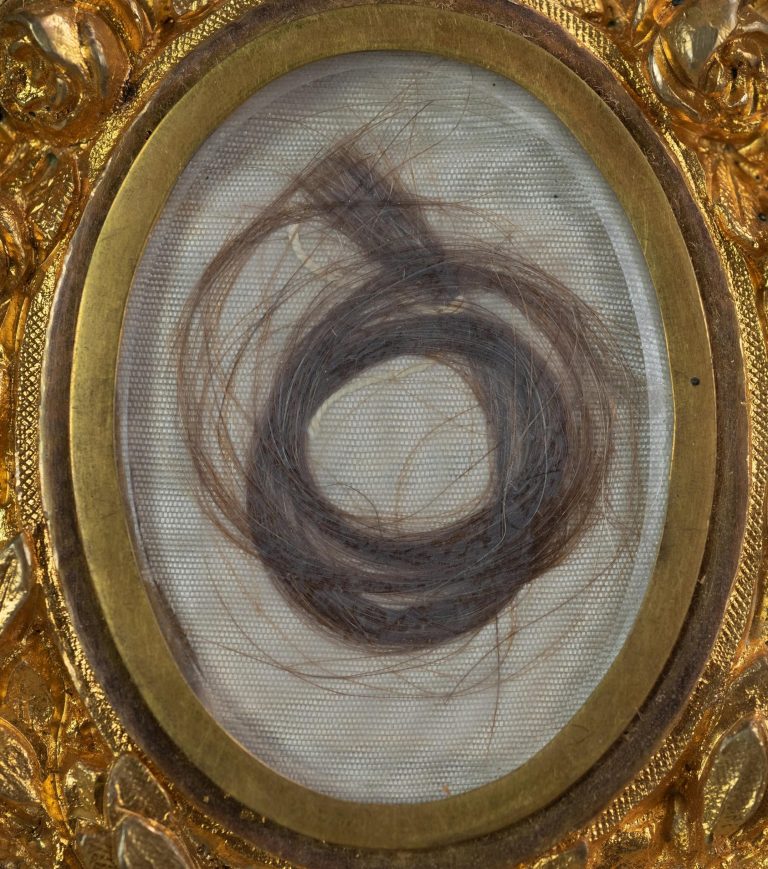
In fact, the “queue” styled at the nape of the neck was a standard military hairstyle equivalent to today’s buzz cut. When the younger Pierie followed in his father’s barbering footsteps, he used Martin’s trove of presidential pile to curry favor or to advertise his own hair-cutting services. The Pieries’ ready access to similar, if less desirable locks, raises questions about the authenticity of the Washington hair samples they distributed.
A young Washington demonstrated his honest character after coming clean about chopping down his father's cherry tree
The painting, The Courtship of Washington by John C. McRae, was painted in 1860, long after Washington’s death in 1799. But a project out of the University of Virginia called The Papers of George Washington also confirms that the first president’s natural hair color was light brown. The style he favored wasn’t fancy, though it may appear so to modern eyes. It was a military style called a queue, "the 18th-century equivalent of a marine buzz cut," Krulwich writes.
Lady Gaga cancels sister’s bachelorette party at LES club The Box after pressure over sex harassment suit
People gave hair as pre-engagement gifts, or as memorials, or just to say, "You're special. Here is hair." That's because, like many in his day, he had a habit of giving it away. Please check our hours and admission page for hours and closings due to holidays and other events. We require all people entering our building to wear a face mask and provide proof of vaccination. As of 1 February 2022, this includes receiving an FDA-authorized COVID-19 vaccination along with a follow-up booster.
The Washingtons used style in politics

His step-grandson, George Washington Parke Custis, recounts a story in which the General hurls a piece of slate across the Rappahannock River in Fredericksburg, Virginia. This would have been a more plausible feat, as the Rappahannock is much narrower than the Potomac.

Supposedly he lost his teeth by cracking Brazil nuts between his jaws. One set of dentures was carved from hippopotamus tusk and had a space to accommodate the single tooth. This caused almost constant pain, which he tried to ease with laudanum. In the British Army a tough hair yank was a rite of passage for young officers; it was common to yank really hard. She also helps make history fun and accessible with her podcast The Digital Dust Podcast, which covers topics on everything from art history to grad school. During his presidency, he witnessed the rise of the Democratic-Republican party in opposition to the Federalists and worried that future political squabbles would undermine the concept of popular sovereignty in the United States.
COLLECTIONS
Trump's height, weight and more information from Georgia jail booking - The Washington Post - The Washington Post
Trump's height, weight and more information from Georgia jail booking - The Washington Post.
Posted: Thu, 24 Aug 2023 07:00:00 GMT [source]
And if the shaft of the hair is tested, it can destroy the sample. "It's kind of this very curious yellow-gray hair," Myers said. A young George is said to have been unable to fib about chopping into his father's plant with a hatchet. “A lot of these objects were donated around that time because the families of the Founding Fathers were feeling squeezed out by nouveau riche American society,” Hill told the newspaper, which first reported the college’s discovery. Heidi Hill, site manager of the Schuyler Mansion in Albany, told the Times Union newspaper that the book may have been donated for the college’s first Founders Day in 1937. One remaining question is just how the old almanac hiding Washington’s hair ended up in Union College’s collection.
"...A fascinating, witty history of the bodily basis for memory and commemoration in the Early Republic." "How do you cherish the memory of your dead father? Keith Beutler’s fascinating book suggests this is more complicated than we might expect. In investigating this unexplored aspect of the founding, Beutler reveals there is more here than meets the eye." Snuffbox repurposed to contain the hair of George Washington, nineteenth century. Inscribed “Hair of Gen. Washington given by/ Mrs. Washington/to Mrs. R.C. Derby/and by her presented/on her death bed/to/J.C. Gifting someone a lock of your hair might seem a bit odd today. But in the 18th and 19th centuries, hair was a perfectly normal keepsake to give to friends, romantic partners, and the relatives in charge of your family’s hair wreath.
But experts have reason to believe that the hair did indeed once belong to the Washington. Union College staff consulted with John Reznikoff, a manuscript and documents dealer who has collected the illustrious locks of Washington, Abraham Lincoln, Beethoven, Napoleon and other historical titans. The hairs at Union College can’t be subjected to DNA analysis, which would destroy them, but based on his examination of several photographs, Reznikoff is as sure as he can be that the strands hail from the head of the nation’s first president. No one knows how many Washington hair samples exist, or how many are really his. The Mount Vernon Ladies’ Association holds the single largest collection, with some sixty examples, but there are many more distributed throughout the United States and abroad. Whether contained in simple paper packets or in elaborate pieces of mourning jewelry, most of these bear inscriptions or accompanying papers documenting their provenance.
His ensemble represented a complex, modest, hard-working, and of-the-people man who was chosen to lead a dream of a new country that many fought and died to see realized. Later on, a painting from Washington’s second term as President shows him in a more formal black suit, which reflected the importance of his station. Throughout his lifetime, George Washington cultivated hemp at Mount Vernon for industrial uses. The fibers from hemp held excellent properties for the making of rope and sail canvas, thread for clothing, and for use in repairing the large seine fishing nets used in his fishing operations along the Potomac.
George Washington - Lock of hair - Aleteia
George Washington - Lock of hair.
Posted: Thu, 15 Feb 2018 08:00:00 GMT [source]
For the next several weeks, the college staff reached out to every George Washington hair expert it could find. Except, Myers didn't get to read any of that before he flipped the front cover open and saw a tiny envelope sitting loose inside, upon which was written "Washington's hair." The book, as you might expect from an almanac, is not exactly thrilling reading. It is full of population estimates and monetary calculations. Schuyler had written notes in the margins about preserving beef, and who was in Congress and who had left Congress, and his business affairs.
The hair was discovered in an envelope labeled "Washington's hair" inside an almanac that had once been owned by the father of Eliza Hamilton, Alexander Hamilton's wife. "It could be destructive to do DNA testing," India Spartz, Union College's head of special collections and archives, told ABC News. Union College believes it is now the guardian of one of 16 locks of Washington's hair known to exist, and is now working to preserve the strands and put them on display.
There's a lock on display at Mount Vernon, for example, which his wife Martha is said to have cut from his head at the end of his presidency and given to friends, who put it in a locket. There are a few interesting myths about Washington’s appearance that have somehow persisted until today. Washington did wear dentures in the later years of his life, but they were likely made of ivory. The myth that they were wooden originated in the 1800s, possibly because Ivory dentures became easily stained. How did a Founding Father’s follicles end up in a dusty almanac stored at Union College?
Despite the mess, powdered hair kept any unwelcomed smells at bay – since frequent bathing wasn’t the norm. Since it is highly unlikely that the root of a strand is attached to the hair, the DNA test is limited, according to Bettinger, but it could provide in-depth knowledge of Washington's family history. Verification that the DNA was Washington's would take a comparison between the results and another person from his family's maternal line, said Bettinger.
The tresses would be locked into place with pomade or even the natural oils on the scalp. When you picture George Washington, you likely envision a double-breasted suit jacket, matching breeches, linen cravat, and a beautifully crafted white hairdo. Most of us can recall that iconic curly coif in an instant – if not, simply open your wallet and take a look at a dollar bill – but the story behind Washington’s hair might surprise you. America's Founding Fathers had some truly defining locks, but we tend to think of those well-coiffed white curls—with their black ribbon hair ties and perfectly-managed frizz—as being wigs. Not so in the case of the main man himself, George Washington. Ironically, this iconic story about the value of honesty was invented by one of Washington’s first biographers, an itinerant minister and bookseller named Mason Locke Weems.
With charming illustrations, artist Wendy MacNaughton brings to life Washington’s routine — the gathering, enthusiastic yank back to try and broaden the forehead, fluffing of the hair on the side and the powdering. Another misconception is that Washington always had white hair or wore wigs. He actually never wore wigs, preferring his natural hair styled in the fashion of the time, and sometimes powdered to appear white. In portraits of a younger Washington, his hair is naturally a reddish brown.
While we have many portraits of Washington, surprisingly, very few were created from life. Washington apparently hated sitting for portraits, thinking they were a waste of his time. For this reason, many images we see of him today are copies, and many of them look quite different from each other. In December, an archivist at Union College in Schenectady, New York, was sorting through some of the college’s oldest books and records when he spotted an 18th-century, leather-bound almanac that had never before been catalogued. The book was titled Gaines Universal Register or American and British Kalendar for the year 1793, and its pages were filled with population estimates for the American colonies and comparisons of various coins.


No comments:
Post a Comment